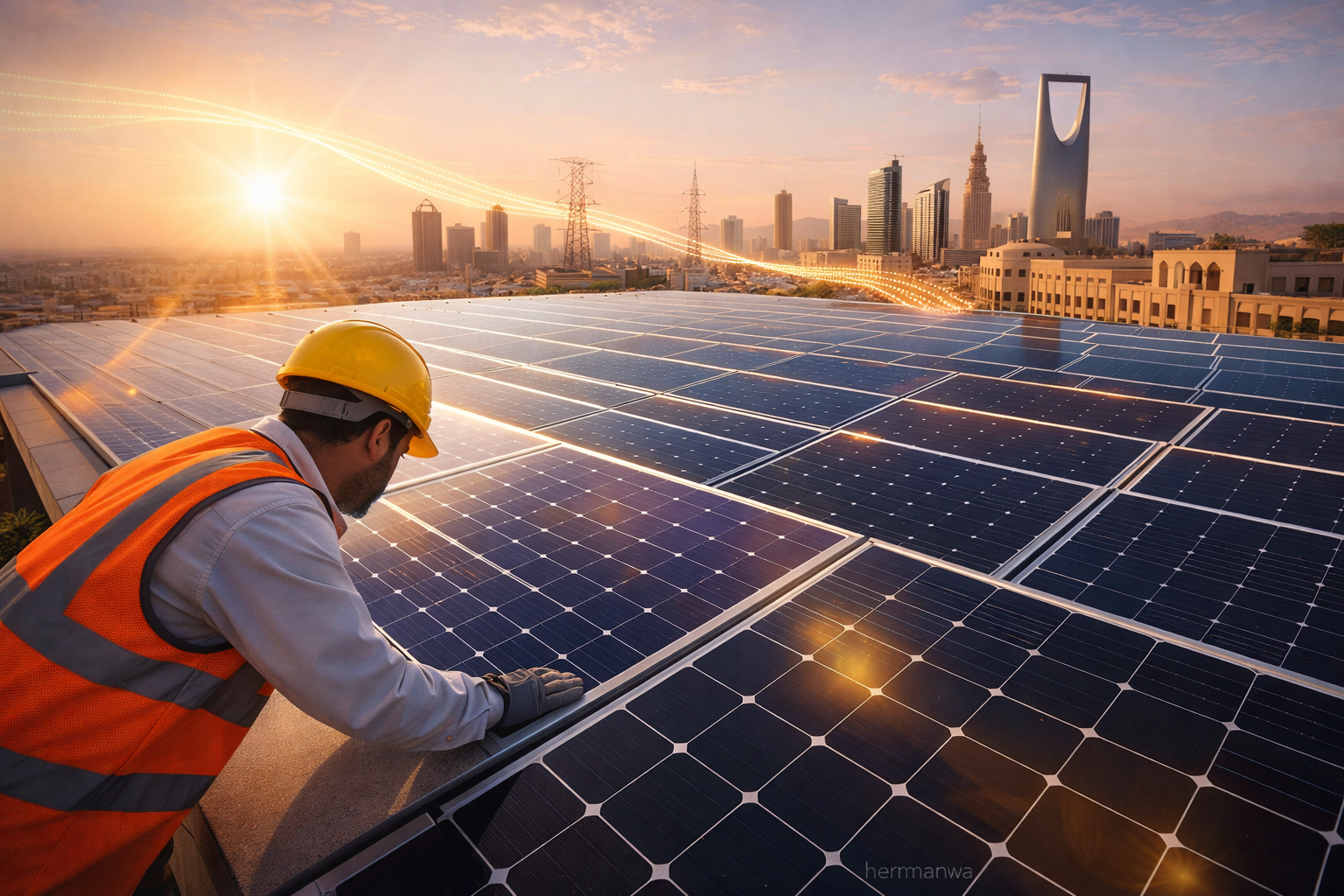
Saudi Arabia's solar sector has undergone a remarkable transformation. In just five years, the Kingdom has added over 12 GW of solar capacity, breaking into the top 10 global markets and fundamentally reshaping the economics of renewable energy across the GCC. For hotel owners and operators throughout the Middle East, this boom offers valuable lessons and unprecedented opportunities.
The confluence of plummeting panel costs, aggressive government targets, and some of the world's highest solar irradiance levels means on-site solar is no longer a premium add-on for eco-conscious properties. It's becoming a financial imperative. This guide examines what the Saudi solar surge means for hospitality assets across the region and how to capitalize on the opportunity.
The GCC Solar Landscape: A Region Transformed
The Gulf Cooperation Council countries have pivoted dramatically toward solar power over the past decade. What began as pilot projects and vision statements has evolved into one of the world's most dynamic renewable energy markets.
Saudi Arabia: Leading the Charge
Saudi Arabia's Vision 2030 targets 50% renewable energy in the electricity mix by 2030, up from essentially zero in 2015. The Kingdom has achieved this through:
- Utility-scale procurement: Projects like the 1.5 GW Sudair Solar Plant and the 2 GW Al Shuaibah facility demonstrate world-class execution
- Record-low tariffs: Bids below $0.02/kWh have made solar the cheapest source of new electricity generation
- Distributed generation frameworks: New regulations enabling rooftop and on-site commercial installations
- Giga-projects: NEOM, The Red Sea Project, and AMAALA incorporating solar from inception
UAE: Mature Market, Strong Infrastructure
The UAE has built comprehensive solar infrastructure over the past decade, with Dubai and Abu Dhabi leading distinct approaches:
- Dubai: The Mohammed bin Rashid Al Maktoum Solar Park will reach 5 GW capacity, while the Shams Dubai program has enabled thousands of rooftop installations
- Abu Dhabi: The 2 GW Al Dhafra Solar Project and strong net metering policies support distributed generation
- Regulatory clarity: Clear interconnection procedures and standardized PPAs reduce project risk
Emerging Markets: Qatar, Bahrain, Oman
Other GCC nations are accelerating their solar programs:
- Qatar: The 800 MW Al Kharsaah plant and sustainability commitments around the 2022 World Cup have catalyzed development
- Oman: The 500 MW Ibri II project and favorable solar resources in the interior regions
- Bahrain: Smaller scale but growing rooftop adoption with supportive net metering
GCC Solar Irradiance Advantage
The GCC region receives 1,800-2,200 kWh/m2 of annual solar irradiance, compared to 1,000-1,400 kWh/m2 in Central Europe. This 50-80% advantage translates directly into faster payback periods and higher returns on solar investments. A system that takes 8 years to pay back in Germany may achieve payback in 4-5 years in the Gulf.
Rooftop vs. Ground-Mount: Choosing the Right Configuration
Hotels face a fundamental choice in solar deployment: utilize existing roof space or develop ground-mounted arrays. Each approach has distinct advantages depending on your property type and circumstances.
Rooftop Solar: The Default Choice for Most Hotels
For urban and suburban hotels, rooftop installations typically offer the best value proposition:
- No land cost: Utilize existing structural assets rather than consuming valuable real estate
- Reduced cooling loads: Panels shade the roof, cutting air conditioning demand by 10-25% in covered areas
- Shorter interconnection: Proximity to electrical infrastructure minimizes connection costs
- Visual integration: Modern low-profile panels maintain architectural aesthetics
- Typical capacity: 200-800 kWp for mid-scale hotels, 1-3 MWp for large resort properties
Key considerations for rooftop systems include structural load capacity (typically 15-25 kg/m2 for panels plus mounting), roof condition and remaining lifespan, and shading from adjacent buildings or rooftop equipment.
Ground-Mount Systems: Resort and Campus Applications
Ground-mounted arrays suit properties with available land and specific requirements:
- Larger capacity: Not constrained by roof space, enabling systems of 5 MWp or more
- Optimal orientation: Panels can be positioned at ideal tilt angles and azimuths
- Easier maintenance: Ground-level access simplifies cleaning and repairs
- Tracking options: Single or dual-axis trackers can boost output by 15-30%
- Guest experience: Solar installations can become educational attractions for eco-tourism
Ground-mount systems require careful site planning to avoid guest view corridors, maintain landscape aesthetics, and ensure security. They work particularly well for desert resorts, golf properties with peripheral land, and hospitality developments in early planning stages.
| Factor | Rooftop | Ground-Mount |
|---|---|---|
| Upfront cost per kWp | $700-1,000 | $600-900 |
| Land/space requirement | Existing roof | ~2 hectares per MWp |
| Secondary benefits | Roof shading, cooling reduction | Guest experience, tracking options |
| Maintenance access | Requires roof access | Easy ground-level |
| Best suited for | Urban/suburban hotels | Resorts, campus properties |
PPA vs. Ownership: Financial Models Compared
The choice between a Power Purchase Agreement (PPA) and direct ownership fundamentally shapes your solar investment returns. Understanding both models is essential for making the right decision for your portfolio.
Power Purchase Agreement (PPA)
Under a PPA, a third-party developer owns, installs, and maintains the solar system on your property. The hotel purchases the electricity generated at a contracted rate, typically 15-25% below grid tariffs.
Advantages:
- Zero upfront capital investment
- No maintenance responsibility or performance risk
- Immediate electricity cost savings
- Off-balance-sheet treatment for many accounting standards
- Straightforward path to renewable energy claims
Considerations:
- Lower total savings over system lifetime (developer captures portion of value)
- Long-term contracts (typically 20-25 years) with limited flexibility
- No asset ownership or appreciation benefit
- Potential complications in property sale or refinancing
Direct Ownership
With direct ownership, the hotel purchases the solar system outright (or through financing) and captures 100% of the electricity value.
Advantages:
- Maximum long-term returns (capture all savings after payback)
- Asset ownership adds to property value
- Complete control over system operation and upgrades
- Potential eligibility for accelerated depreciation benefits
- No long-term third-party contracts on the property
Considerations:
- Requires capital allocation (typically $700-1,000 per kWp installed)
- Responsibility for maintenance and performance
- Technology and operational expertise needed
- Initial balance sheet impact
| Criteria | PPA Model | Ownership Model |
|---|---|---|
| Upfront investment | $0 | $700-1,000/kWp |
| Year 1 savings | 15-25% vs grid | 40-60% vs grid (after financing) |
| 25-year total savings | $150-200/kWp | $400-600/kWp |
| Maintenance responsibility | Developer | Owner (can outsource) |
| Contract duration | 20-25 years | No third-party contract |
| Best for | Capital-constrained, risk-averse | Long-term holders, value maximizers |
Financing Tip
Many regional and international banks now offer green financing for solar projects at preferential rates (50-100 basis points below standard commercial rates). This can make ownership economics attractive even for hotels that would typically prefer PPA structures. Ask your banking relationships about green loan options before defaulting to a PPA.
ROI Calculations and Payback Periods
Understanding the financial returns of hotel solar requires examining multiple variables specific to GCC conditions.
Key Input Variables
- System cost: $700-1,000 per kWp installed (declining 5-8% annually)
- Annual generation: 1,600-1,900 kWh per kWp in the GCC (varies by location and system type)
- Electricity rates: $0.08-0.15 per kWh depending on emirate and consumption tier
- Annual degradation: 0.5% output reduction per year
- O&M costs: $8-15 per kWp annually
- System lifespan: 25-30 years
Illustrative Returns: 500 kWp Hotel Rooftop System
For a mid-scale hotel installing a 500 kWp rooftop system in Dubai:
- Installation cost: $425,000 (at $850/kWp)
- Annual generation: 875,000 kWh (Year 1)
- Electricity value: $87,500/year (at $0.10/kWh)
- Annual O&M: $6,000
- Net annual benefit: $81,500
- Simple payback: 5.2 years
- 25-year NPV: $680,000 (at 8% discount rate)
- IRR: 18-22%
Factors That Improve Returns
- Higher electricity rates (properties in peak tariff tiers benefit most)
- Strong net metering policies that credit excess generation
- Cooling load reduction from roof shading
- Green financing with preferential rates
- Brand recognition value and ESG positioning
Grid Connection Requirements by Country
Successful solar integration requires navigating country-specific interconnection procedures. Understanding these requirements upfront prevents costly delays.
United Arab Emirates
Dubai (DEWA):
- Shams Dubai program governs all rooftop installations
- Approved contractor requirement for installation
- Net metering with full retail credit for exports
- Typical approval timeline: 4-8 weeks
- System size limits: Up to facility contract demand
Abu Dhabi (ADDC/AADC):
- Net metering available for systems up to contract demand
- Grid impact study required for larger installations
- Approval timeline: 6-12 weeks
- Recent regulatory updates have streamlined processes
Saudi Arabia
- Saudi Electricity Company (SEC) manages interconnection
- Distributed generation framework updated in 2023
- Net metering available for systems up to 2 MW
- Longer approval timelines (8-16 weeks) but improving
- NEOM and Red Sea projects have dedicated regulatory pathways
Other GCC Markets
- Qatar: Kahramaa manages interconnection; framework evolving post-World Cup
- Bahrain: EWA offers straightforward net metering for commercial installations
- Oman: OETC/distribution companies; framework maturing with recent policy updates
Interconnection Best Practice
Engage with grid authorities early in project planning. Pre-application consultations can identify potential issues before significant investment. Most utilities now have dedicated renewable energy departments that can guide commercial projects through requirements.
Case Studies: Solar Success in GCC Hospitality
The Red Sea Project, Saudi Arabia
This flagship development demonstrates the integration of solar from the earliest planning stages. The project targets 100% renewable energy for all resort operations, combining utility-scale solar (up to 400 MW planned capacity) with battery storage to achieve 24/7 clean power. Hotels in the development will have no grid connection, relying entirely on the solar-plus-storage microgrid. This ambitious approach creates a new benchmark for sustainable hospitality in the region.
Desert Resort Portfolio, UAE
A luxury desert resort operator implemented a 2.5 MW ground-mount system across three properties. Key outcomes included 65% reduction in grid electricity purchases, AED 2.8 million annual savings, and enhanced guest experience through solar education programs. The project paid back in 4.8 years and now generates approximately AED 3 million in annual value.
Urban Hotel Group, Dubai
A portfolio of six urban hotels implemented rooftop solar across all properties, totaling 1.8 MW of installed capacity. Using a PPA structure due to capital constraints during the project period, the group achieved immediate 20% electricity cost reduction with no upfront investment. The success has led to plans for ownership-model expansions at future properties.
Implementation Steps: Your Solar Roadmap
Successfully implementing solar at your hotel requires systematic planning and execution. Here's the recommended pathway:
Phase 1: Assessment (4-6 weeks)
- Energy audit: Analyze 24-month electricity consumption patterns and peak demand periods
- Site evaluation: Assess roof condition, structural capacity, shading analysis, and available area
- Regulatory review: Confirm local interconnection requirements and net metering policies
- Financial modeling: Develop preliminary ROI analysis for various system sizes and configurations
Phase 2: Procurement (6-10 weeks)
- RFP development: Prepare detailed specifications for contractor bidding
- Vendor selection: Evaluate proposals on technical merit, pricing, and track record
- Contract negotiation: Finalize terms for EPC (ownership) or PPA agreements
- Financing arrangement: Secure green loans or corporate approval for capital deployment
Phase 3: Permitting (4-12 weeks)
- Utility application: Submit interconnection requests with required documentation
- Building permits: Obtain structural and electrical approvals as required
- Grid study: Complete any required impact assessments for larger systems
- Final approvals: Receive permission to proceed with installation
Phase 4: Construction (8-16 weeks)
- Equipment delivery: Coordinate panel, inverter, and mounting system arrival
- Installation: Execute physical installation with minimal operational disruption
- Testing: Commission system and verify performance
- Interconnection: Complete final utility inspection and grid connection
Phase 5: Operation (Ongoing)
- Monitoring: Implement real-time performance tracking and alert systems
- Maintenance: Execute regular cleaning and preventive maintenance programs
- Optimization: Continuously improve system performance and capture additional value
- Reporting: Integrate solar generation data into ESG and financial reporting
Ready to Explore Solar for Your Hotel?
Our team helps hospitality portfolios evaluate solar opportunities, from initial feasibility through implementation.
Request a Solar AssessmentSummary: The Solar Imperative for GCC Hotels
Saudi Arabia's 12 GW solar achievement demonstrates that utility-scale deployment at pace is achievable in the GCC. For hotel owners and operators, the implications are clear:
- Economics are compelling: 4-7 year paybacks with 18-22% IRRs make solar a strong financial investment, not just an ESG initiative
- Technology is proven: Thousands of commercial installations across the region provide operational track records and experienced contractors
- Regulations are supportive: Net metering, streamlined interconnection, and green financing create favorable policy environments
- Competition is moving: Early adopters are already capturing savings and positioning their properties for increasingly eco-conscious guests and investors
- Grid parity has arrived: Solar is now cheaper than grid electricity in most GCC contexts, making inaction costly
The question for hotel owners is no longer whether to pursue solar, but how quickly and at what scale. With the lessons from Saudi Arabia's rapid expansion as a guide, the path forward is clearer than ever.