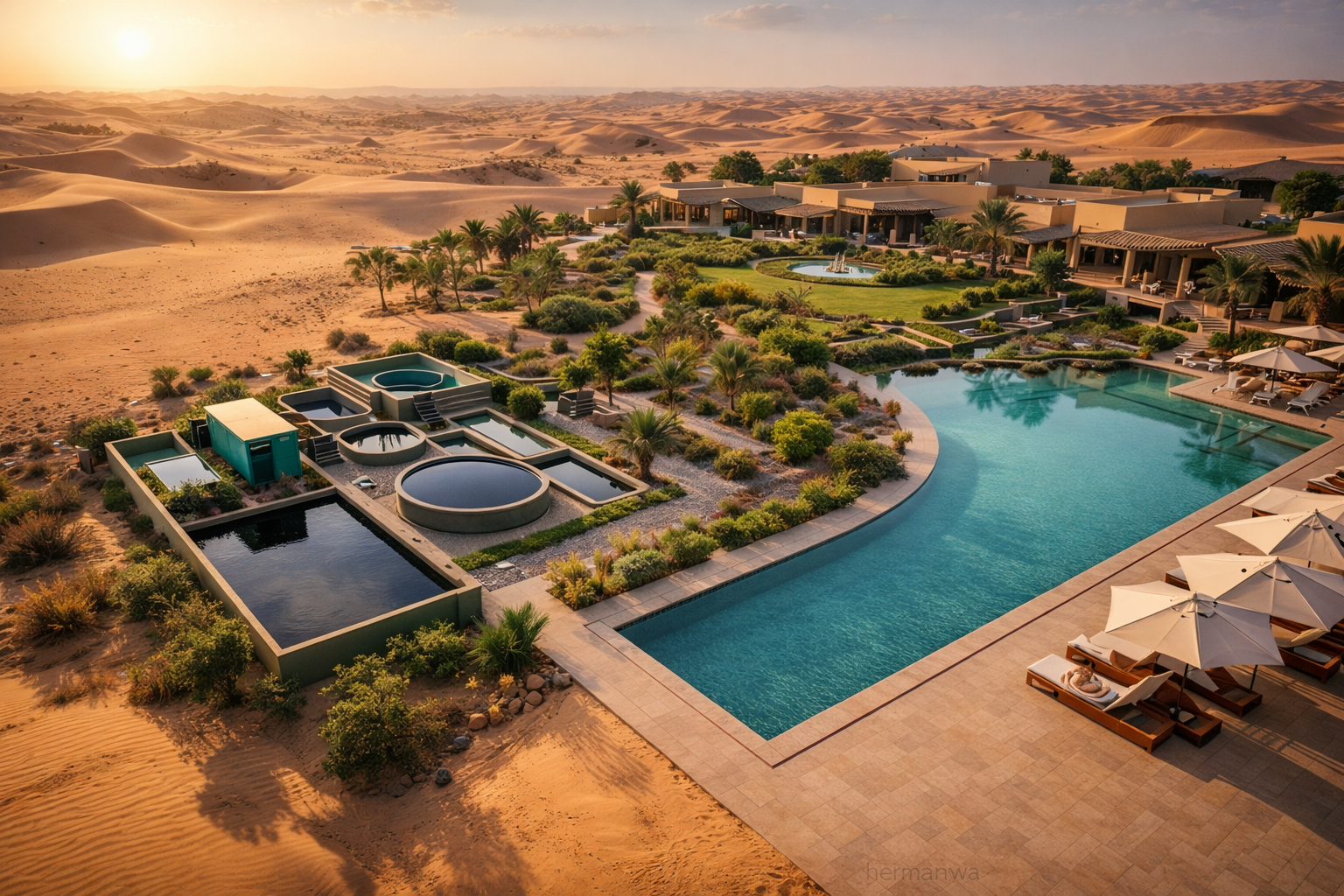
The World Bank projects that climate-related water scarcity could cost the Middle East and North Africa region up to 14% of GDP by 2050. For hospitality operators in the Gulf Cooperation Council states, this is not a distant threat but an immediate operational reality. Water in the GCC is fundamentally different from water anywhere else in the world, and hotels that treat it as a commodity like any other are leaving substantial value on the table.
Installing low-flow showerheads and dual-flush toilets was a meaningful step a decade ago. Today, it is table stakes. Hotels serious about water stewardship, cost control, and genuine sustainability must look far beyond these basic measures to comprehensive water management strategies that address the full cycle of consumption, treatment, and reuse.
The True Cost of Water in the GCC
Understanding water economics in the Gulf requires grasping one fundamental fact: virtually all potable water in the GCC comes from desalination. The region has no significant freshwater lakes, minimal groundwater that has not been depleted or salinized, and rainfall that averages less than 100mm annually across most areas.
Desalination is extraordinarily energy-intensive. Producing one cubic meter of potable water through reverse osmosis requires approximately 3-4 kWh of electricity, while thermal desalination methods consume 10-15 kWh equivalent. This energy consumption translates directly into carbon emissions and cost.
The Hidden Carbon Cost of Water
Every 1,000 liters of desalinated water in the GCC carries an embedded carbon footprint of 2-8 kg CO2e, depending on the desalination technology and local grid carbon intensity. A luxury resort consuming 500,000 liters daily generates 350-1,400 tonnes of Scope 2 emissions annually from water alone.
The financial implications are equally stark. While government subsidies historically masked true water costs, these subsidies are being systematically reduced across the GCC as part of fiscal reform programs. In the UAE, commercial water tariffs have increased by over 40% since 2015. Saudi Arabia's Vision 2030 includes phased subsidy removal that will bring water prices closer to actual production costs.
For hotel operators, the combined effect of high base consumption, rising tariffs, and carbon accounting requirements creates a compelling case for aggressive water conservation investment.
Current Consumption Benchmarks by Hotel Type
Before implementing conservation measures, operators need to understand where they stand relative to industry benchmarks. Water consumption in hotels varies dramatically based on property type, amenities, and operational efficiency.
| Hotel Category | Average Consumption (L/guest night) | Best Practice Target | Key Consumption Drivers |
|---|---|---|---|
| Budget/Limited Service | 300-500 | 200-300 | Guest rooms, basic amenities |
| Mid-Scale Business | 500-800 | 350-500 | F&B operations, meeting spaces |
| Full-Service Luxury | 800-1,200 | 500-700 | Multiple restaurants, spa, pools |
| Beach Resort with Landscaping | 1,200-2,000 | 700-1,000 | Irrigation, extensive pools, water features |
| Golf Resort | 2,000-3,500 | 1,200-1,800 | Course irrigation (dominant factor) |
These benchmarks reveal a critical insight: the largest water consumers are not guest rooms but rather ancillary operations. Landscaping irrigation, cooling towers, pools, and food and beverage operations often account for 60-70% of total hotel water consumption. Any serious conservation strategy must address these areas, not just guest-facing fixtures.
Greywater Recycling Systems
Greywater recycling represents one of the highest-impact water conservation investments available to hotels. Greywater, defined as wastewater from showers, basins, and laundry (excluding toilet waste or kitchen effluent), typically constitutes 50-60% of total hotel wastewater volume. This water, with appropriate treatment, can be safely reused for irrigation, toilet flushing, and cooling tower makeup.
How Hotel Greywater Systems Work
Modern greywater treatment systems for hotels typically employ a multi-stage process:
- Collection: Separate plumbing diverts greywater from showers, bathtubs, basins, and laundry to a dedicated holding tank
- Primary filtration: Screens and settling tanks remove hair, lint, and larger particulates
- Biological treatment: Membrane bioreactors (MBR) or sequencing batch reactors break down organic matter
- Tertiary treatment: Ultrafiltration and UV disinfection ensure water meets quality standards for reuse
- Storage and distribution: Treated water is stored and pumped to irrigation systems, toilet cisterns, or cooling towers
Well-designed systems achieve 60-70% recovery rates, meaning a hotel generating 100,000 liters of greywater daily can recover 60,000-70,000 liters for reuse.
Implementation Considerations
- Retrofit installations require parallel piping infrastructure, significantly increasing costs versus new-build integration
- Treatment systems require dedicated plant room space of 50-150 square meters depending on capacity
- Ongoing maintenance includes membrane replacement, chemical dosing, and water quality monitoring
- Regulatory approvals vary by emirate; engage authorities early in the planning process
Financial Analysis
For a 300-room luxury hotel in Dubai consuming 900 liters per guest night at 70% occupancy:
- Daily water consumption: approximately 190,000 liters
- Greywater available: approximately 95,000 liters (50%)
- Recoverable water at 65% efficiency: approximately 62,000 liters daily
- Annual water savings at AED 12/cubic meter: approximately AED 270,000
- System cost (retrofit): AED 600,000-900,000
- Simple payback: 2.5-3.5 years
On-Site Water Treatment
For larger resorts and hotel complexes, on-site wastewater treatment plants offer even greater water recovery potential by processing blackwater (toilet waste) alongside greywater. These systems are particularly relevant for isolated resort properties without municipal sewage connections or those seeking maximum water independence.
Treatment Technologies
Hotel-scale wastewater treatment typically employs one of several technologies:
- Membrane Bioreactors (MBR): Combine biological treatment with membrane filtration for high-quality effluent suitable for irrigation and non-potable reuse
- Sequential Batch Reactors (SBR): Lower capital cost but require more operator attention and produce lower quality effluent
- Constructed Wetlands: Natural treatment systems suitable for resorts with available land; low operating costs but high space requirements
- Package Plants: Containerized systems suitable for smaller properties; quick deployment but higher per-unit treatment costs
Regulatory Requirements
On-site treatment plants require environmental permits and regular effluent quality testing. In Dubai, this falls under Dubai Municipality oversight. Abu Dhabi properties work with the Environment Agency. Non-compliance carries significant penalties and reputational risk. Budget for ongoing compliance costs in your financial analysis.
Integration with Irrigation
Treated wastewater, often called Treated Sewage Effluent (TSE), is the standard water source for landscape irrigation across the GCC. Hotels with on-site treatment can directly supply their irrigation systems while potentially selling excess TSE to municipal authorities or neighboring properties.
Landscaping Alternatives: Xeriscaping for Desert Hotels
Traditional hotel landscaping in the GCC has often mimicked temperate climate designs, featuring extensive lawns, tropical plants, and high-water ornamental gardens. This approach is fundamentally misaligned with desert environments and represents one of the largest water consumption categories for resort properties.
Xeriscaping, designing landscapes for minimal water use, offers a compelling alternative that can reduce irrigation requirements by 50-75% while creating distinctive, regionally appropriate aesthetics.
Principles of Desert-Appropriate Landscaping
- Native and adapted plant selection: Species evolved for arid conditions require minimal supplemental irrigation once established
- Hydrozoning: Grouping plants by water requirements ensures efficient irrigation without overwatering drought-tolerant species
- Soil improvement: Adding organic matter increases water retention, reducing irrigation frequency
- Efficient irrigation: Drip systems and subsurface irrigation deliver water directly to root zones with minimal evaporative loss
- Mulching: Organic or inorganic mulches reduce surface evaporation by 50-70%
- Hardscape integration: Strategic use of stone, gravel, and architectural elements reduces planted area while maintaining visual appeal
| Plant Type | Water Requirement | Applications | Examples |
|---|---|---|---|
| Native Trees | Very Low (established) | Shade, structure | Ghaf, Sidr, Acacia |
| Date Palms | Moderate | Iconic focal points | Phoenix dactylifera varieties |
| Desert Succulents | Very Low | Ground cover, accents | Agave, Aloe, Euphorbia |
| Flowering Shrubs | Low-Moderate | Color, screening | Bougainvillea, Lantana, Tecoma |
| Ornamental Grasses | Low | Texture, movement | Pennisetum, Muhlenbergia |
| Traditional Turf | Very High | Avoid or minimize | Replace with alternatives |
Smart Irrigation Systems
Even xeriscaped landscapes require some irrigation, particularly during plant establishment and peak summer months. Smart irrigation systems maximize efficiency through:
- Weather-based controllers: Adjust watering schedules based on evapotranspiration data, reducing irrigation during cooler periods
- Soil moisture sensors: Water only when soil moisture drops below optimal levels
- Flow monitoring: Detect leaks and system failures that cause water waste
- Zone-specific scheduling: Different areas receive appropriate irrigation based on plant requirements and microclimate
Guest Engagement Strategies
Technology and infrastructure deliver the largest water savings, but guest behavior significantly impacts overall consumption. Effective engagement strategies can reduce guest room water use by 10-20% without compromising experience quality.
Effective Approaches
- Transparent communication: Explain the local water context and hotel conservation efforts without lecturing or guilt-tripping
- Linen and towel reuse programs: Standard practice but often poorly implemented; clear signage and genuine follow-through are essential
- Shower timers: Subtle digital displays showing shower duration raise awareness without being intrusive
- In-room water consumption displays: Some advanced properties provide real-time water use feedback via in-room tablets
- Gamification: Recognition programs for guests who participate in conservation efforts
What Does Not Work
Heavy-handed messaging, making guests feel guilty, or visibly degraded service in the name of conservation all backfire. Luxury guests expect full amenity availability; the goal is reducing waste without impacting perceived quality. Focus messaging on environmental stewardship and regional context rather than cost savings.
Staff Training
Staff behavior impacts water consumption across all operational areas. Effective training programs should cover:
- Housekeeping water use during room cleaning and turnover
- Kitchen water management including pre-rinse spray valves and dishwasher loading
- Laundry operations and optimal load sizes
- Pool and spa water management
- Landscape irrigation oversight and leak reporting
ROI Analysis and Investment Prioritization
Water conservation investments should be evaluated like any capital allocation decision, with clear understanding of costs, savings, payback periods, and strategic value.
| Investment Category | Typical Cost Range | Water Savings Potential | Payback Period |
|---|---|---|---|
| Low-flow fixtures upgrade | $50,000-150,000 | 15-25% | 6-18 months |
| Smart irrigation systems | $30,000-80,000 | 20-40% of irrigation | 12-24 months |
| Leak detection systems | $20,000-60,000 | 5-15% | 6-12 months |
| Greywater recycling (retrofit) | $150,000-400,000 | 30-40% | 3-5 years |
| Full xeriscaping conversion | $200,000-500,000 | 50-75% of irrigation | 4-6 years |
| On-site treatment plant | $500,000-1,500,000 | 60-80% | 5-7 years |
Strategic Value Beyond Direct Savings
Financial analysis should incorporate benefits beyond direct water cost reduction:
- Energy savings: Reduced water consumption directly reduces pumping and water heating energy
- Sewer charges: Lower consumption typically reduces wastewater discharge fees
- Carbon reduction: Water savings translate to Scope 2 emissions reductions for ESG reporting
- Brand value: Genuine sustainability credentials increasingly influence booking decisions
- Certification requirements: Major hotel brands mandate water efficiency for brand standards compliance
- Regulatory preparedness: Proactive investment positions properties ahead of tightening regulations
Assess Your Water Conservation Potential
Our water efficiency diagnostic identifies quick wins and strategic investments for your property portfolio.
Request Your Free AssessmentImplementation Roadmap
Effective water conservation requires a phased approach that builds capability while delivering early wins:
Phase 1: Foundation (Months 1-3)
- Install comprehensive water metering to establish baseline and identify consumption patterns
- Conduct water audit to identify leaks, inefficiencies, and priority areas
- Implement no-cost and low-cost measures (behavioral changes, leak repairs, equipment adjustments)
Phase 2: Quick Wins (Months 4-12)
- Deploy smart fixtures and irrigation controllers
- Launch guest engagement program
- Complete staff training across all departments
- Develop business cases for major capital investments
Phase 3: Infrastructure Investment (Years 2-3)
- Install greywater recycling systems
- Execute landscape conversion to water-efficient design
- Integrate water management into building management systems
Phase 4: Optimization (Ongoing)
- Continuous monitoring and adjustment
- Technology upgrades as new solutions emerge
- Performance benchmarking against industry leaders
Summary
Water conservation in GCC hotels is no longer optional. Rising tariffs, carbon accounting requirements, investor expectations, and brand mandates all point in the same direction. Properties that treat water as a precious, expensive resource and invest accordingly will gain competitive advantage through lower operating costs, stronger sustainability credentials, and preparedness for increasingly stringent regulations.
The path forward requires moving beyond basic fixtures to comprehensive water management embracing greywater recycling, smart irrigation, appropriate landscaping, and engaged guests and staff. The investments pay for themselves, often within 2-5 years, while positioning properties for the water-constrained future that is already arriving.